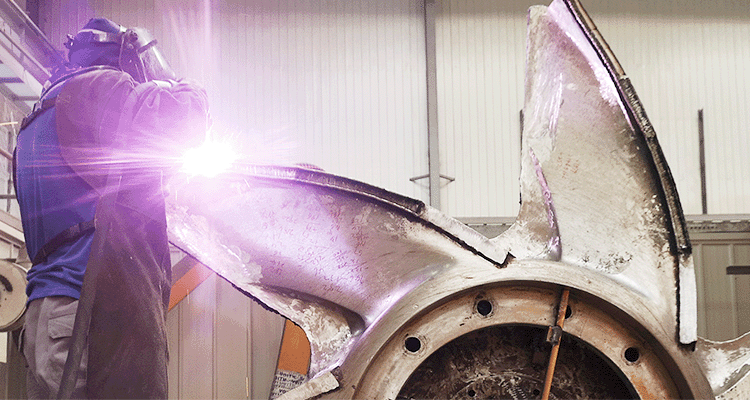
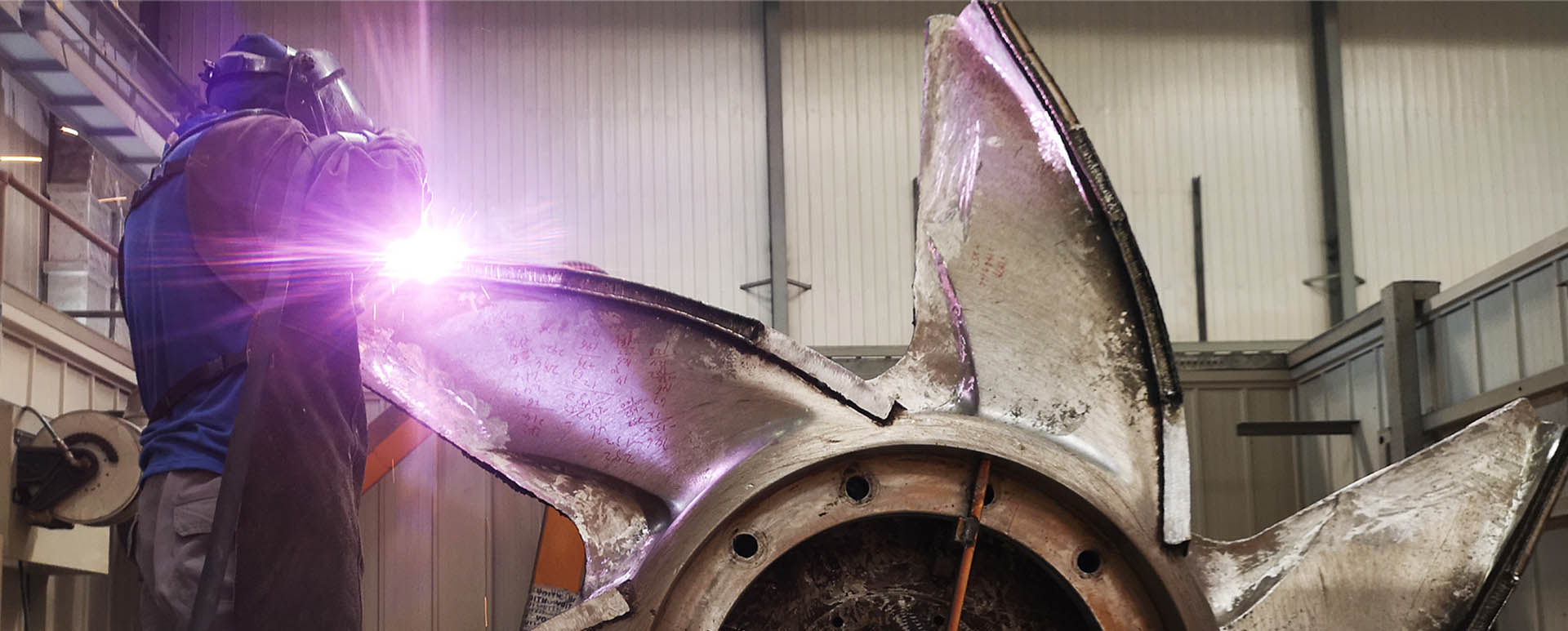
Overcoming the Bottleneck of Internal Wall Welding for Small-Diameter, Large-Bend Heads | AMET Intelligent Manufacturing Tackles the Challenge of Welding Special Alloy for Integrated 90-Grad Elbows.
In the fields of oil and gas, hydrogenation, coal chemical processing, and high-temperature/high-pressure petrochemical equipment, integrated 90-degree elbows with an inner diameter of 261 mm and a bend radius of 1500 mm serve as critical pressure-bearing components in pipeline systems. To withstand high-temperature erosion, strong corrosive media, and particle wear, the inner walls of these elbows require comprehensive welding with three types of corrosion-resistant and wear-resistant alloys: cobalt-based, nickel-based, and stainless steel alloys. Due to the triple constraints of small pipe diameters, extremely large bending radii, and integrated, non-segmented structures, traditional segmented welding and manual internal wall welding methods exhibit significant limitations. Leveraging its multi-axis synchronized internal wall welding machine and closed-loop hot-wire TIG narrow-gap welding technology, AMET Intelligent Manufacturing has established a fully automated continuous welding process for the entire inner wall of integrated large-bend elbows, overcoming multiple industry-wide technical challenges.
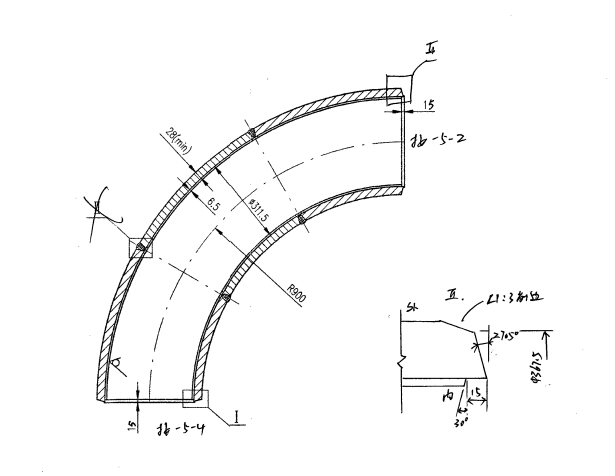
The workpiece's inherent structural design presents fundamental geometric challenges. Specifications: inner pipe diameter DN261, bend radius R1500 (large bend with shallow curvature of 90° for a continuous elbow), no segmented sections or disassembly interfaces—its geometric configuration directly precludes the feasibility of conventional welding methods.
The internal working space is extremely narrow, with significant interference to the welding torch's movement. The elbow's inner diameter is only 261 mm; after accounting for the welding torch's water-cooled housing and wire feeding pipeline, the effective operating clearance is less than 80 mm. The elbow's radius reaches 1500 mm, resulting in a significant difference in curvature between its inner and outer surfaces. The customer requires integrated full-wall overlay welding to eliminate joint defects from segmented assembly, imposing stringent demands on equipment flexibility in trajectory control.
The entire surface features a multi-dimensional continuous trajectory, making uniform welding seam distribution highly challenging. The welding positions for the inner arc, outer arc, and side arc of the bend are entirely distinct, and welds on the same layer must be arranged in a spiral pattern along a circular arc with a radius of approximately 1500 mm.
Under full-blind welding conditions of the inner wall, manual inspection is completely ineffective. The distance between the openings at both ends of the elbow is significant, and the middle section of the bent pipe lies entirely within a visual blind zone, making direct observation of the molten pool impossible.
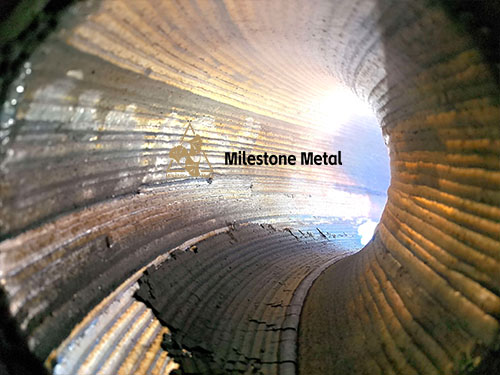
The existing conventional equipment and manufacturing processes exhibit systemic limitations. Current internal wall welding machines are generally only compatible with elbows having a bending radius ≤1000 mm and moderate curvature, leaving significant compatibility gaps when handling ultra-large elbows (R1500) or integral elbows with an inner diameter of 261 mm.
Single-axis simple motion with no multi-axis coordinated compensation. Conventional internal welding machines only feature coordinated operation between rotation and linear feed axes, unable to dynamically adjust the welding gun's amplitude, tilt angle, or travel speed for 1500-mm large-radius arcs in real time. This results in uneven surface weld seam overlap and prevents continuous welding without breaks.
The simple water-cooled gun body cannot operate at high temperatures for extended periods. The preheating temperature of multi-layer welded components can reach 300°C, while the enclosed space within the elbow exhibits poor heat dissipation. Conventional welding guns experience insulation damage and tungsten electrode burnout after brief high-temperature operation, making it impossible to complete continuous multi-layer welding on entire elbows.
The system lacks real-time closed-loop monitoring, forcing defects to be addressed through post-processing. It also does not feature a high-temperature-resistant micro-HD camera system for real-time observation of the molten pool and weld formation, limiting inspection methods to UT/PT testing only after welding. The presence of porosity, cracks, or poor fusion requires extensive grinding and repair work, significantly delaying delivery timelines.
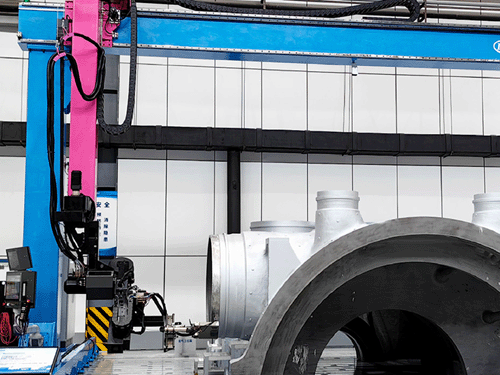
AMET Intelligent Manufacturing's tailored technical breakthrough solution addresses all challenges associated with full-wall special alloy overlay welding for integrated 90-degree elbows with an inner diameter of 261 mm and a bend radius of R1500. Leveraging 25 years of expertise in advanced automated welding technology, AMET has developed a customized integrated multi-axis coordinated hot-wire TIG overlay welding workstation, achieving comprehensive advancements across three key dimensions: mechanical structure, control systems, and process databases.

1. A specialized welding gun module designed for flexible narrow-bend applications, addressing clearance interference in confined spaces with a customized ultra-narrow, lightweight inner-welding gun that accommodates the remaining operational clearance of 261 mm inner diameter elbows; featuring a segmented flexible deflection nozzle capable of adaptive turning along a 1500 mm large-radius arc without friction or jamming, enabling complete penetration through the entire inner wall of a 90-degree elbow in a single pass.
2. Six-axis CNC collaborative control system with precise trajectory compensation for high-curvature surfaces. The CMC-66 multi-axis welding CNC system features a dedicated trajectory algorithm for large-curved elbows, along with parameters for welding layer count and thickness, automatically generating continuous spiral welding trajectories:
The welding torch's oscillation amplitude dynamically adapts to the inner and outer curvature of the elbow, ensuring uniform overlap across the entire inner wall weld seam. Real-time arc-length AVC closed-loop tracking compensates for minor wall displacements caused by thermal deformation while stabilizing arc energy. Multi-axis synchronous dynamic speed control reduces internal arc speed to regulate molten pool flow, while slightly increasing external arc speed to ensure proper deposition, achieving consistent weld quality across all positions (flat, horizontal, or vertical) and eliminating concave or accumulation defects.
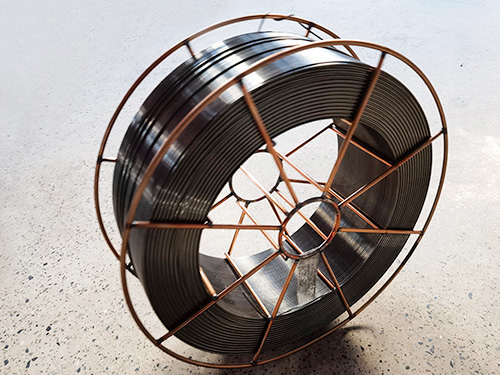
The digital pulse-wire feeding system addresses wire feeding vibration in curved sections by integrating a high-dynamic closed-loop feeding mechanism. Its pulsed, constant-speed feeding eliminates "viscous slip" caused by wire bending within the pipe, with millisecond-level response accuracy. Supporting three types of welding wires (stainless steel, nickel-based, and cobalt-based), it features built-in parameter libraries for wire feeding and preheating, eliminating repeated calibration and significantly reducing production changeover time.
4. A precision thermal control process library for alloys is developed to suppress crack and deformation defects; the AMET precipitation-based complete special alloy elbow overlay welding process specifically addresses core defects of various materials.
Stainless steel overlay welding: employs a low-pulse, low-heat-input process with multi-layer temperature-controlled buffering to suppress overall thermal deformation of the elbow while ensuring intergranular corrosion resistance; Nickel-based alloy overlay welding: utilizes gradient preheating combined with closed-loop temperature monitoring between layers to reduce melt pool flow tendency, minimize Nb element segregation, and stabilize the mechanical and corrosion-resistant properties of the overlay layer; Cobalt-based alloy overlay welding: adopts a low-current, narrow-track multi-layer process that reduces heat input per pass and thermal cycle stress, complemented by a staged slow-cooling procedure to prevent cold-hot cracking in the cobalt base layer from the outset, achieving no crack defects upon initial PT inspection.
5. Integrated single-clamping continuous welding eliminates the need for segmented processing: workpieces are clamped and positioned in one operation using a six-axis positioner with an inner-wall mobile welding gun, fully covering all internal surfaces of the 90-degree elbow without requiring cutting, circumferential seam assembly, or weld repair. This eliminates corrosion-prone weak points in segmented welds and significantly enhances the structural integrity of the elbow, while shortening the manufacturing cycle.
Summary of Practical Application Value: For small-diameter, large-bend-angle 90-degree elbows with an inner diameter of 261 mm and a bend radius of 1500 mm, featuring internal walls coated with cobalt-based, nickel-based, or stainless steel layers, AMET Intelligent Manufacturing's comprehensive automated solution effectively addresses five key industry challenges in a single implementation: spatial geometric constraints, curved surface trajectory control, multi-alloy heterogeneous welding, quality control issues in blind welding, and defects in segmented manufacturing processes.
Quality Enhancement: The integrated seamless inner wall corrosion-resistant coating features uniform welding thickness and compliant dilution ratios, significantly reducing crack, poor fusion, and porosity defects while achieving high first-pass inspection pass rates that meet stringent requirements for nuclear power, hydrogen refueling, and high-temperature oil/gas equipment. Efficiency Improvement: Eliminating multiple processes such as cutting, assembly, re-welding, and repeated inspections reduces the total welding time per elbow by over 50%, enabling batch production. Flexible Adaptability: Utilizes three types of wear-resistant and corrosion-resistant alloys (stainless steel, nickel-based, and cobalt-based) for customized elbow designs across various operating conditions. Automation Replacement: Full-process CNC automated welding eliminates the need for welders to perform hazardous tasks inside sealed elbows, improving working conditions and reducing reliance on skilled labor. Cost Optimization: Minimizes waste from rework, inspection, and machining materials, resulting in significantly lower overall manufacturing costs compared to traditional segmented manual welding methods.